Xinhua
21 May 2026, 21:46 GMT+10
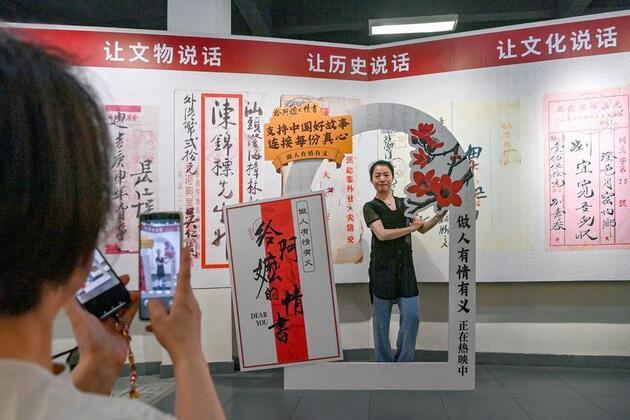
GUANGZHOU, May 21 (Xinhua) -- Near the end of 2022, while searching for ideas for his third film, director and screenwriter Lan Hongchun wandered into a museum dedicated to qiaopi in south China and stayed for an entire day.
Qiaopi -- letters and remittances sent home by earlier generations of overseas Chinese -- once traveled quietly across oceans, carrying longing and news from distant lives back to families waiting in China.
Lan read every letter on display, then bought stacks of research books. "The more I read, the harder it became to let go," he said.
What moved him most was the emotional force hidden behind the fragile paper -- the deep attachment to family and homeland, the resilience and integrity of earlier generations of overseas Chinese.
"I felt I had to tell these stories," Lan said.
Now, they have made their way to the big screen.
"Dear You," a low-budget film shot largely in the Chaoshan, or Teochew, dialect, has become one of China's most unexpected box-office successes this year. As of 5 p.m. Thursday, it had grossed more than 740 million yuan (about 108.27 million U.S. dollars), according to Maoyan, a major film data platform, which projected the film's total theatrical revenue to exceed 1.6 billion yuan.
The tear-jerker drama has also struck a chord with viewers, earning a rare 9.1 rating on Douban, China's leading film review platform.
In the film, Zheng Musheng leaves Guangdong's Chaoshan region during wartime and later works in Thailand, hoping one day to return home. His wife, Ye Shurou, remains in south China, raising their children alone.
After Zheng dies overseas, Xie Nanzhi, a Thailand-based woman of Chaoshan descent who had befriended him, hides the truth about his death and keeps sending letters and money to Ye in his name for nearly two decades.
Separated by the sea and having never met in person, the two women become quietly connected through years of letters, sacrifice and unwavering care.
The emotional depth of the story has offered many younger Chinese audiences a glimpse into the nearly forgotten world of qiaopi.
"It is a beautiful film," said Qi Wenjing, a teacher in Beijing who recently watched it. "The language in those letters, the Chinese calligraphy, the texture of the yellowed paper, all of it carried such deep longing across thousands of miles."
The filmmakers say those emotions were drawn not from imagination, but from real qiaopi archives preserved across south China.
"I realized how many heartbreaking stories passed through those remittance agencies every day," said actress Li Sitong, who plays the lead role of Xie Nanzhi in the film. "Compared with the movie, the real letters are even more moving."
In south China's Guangdong Province, the Chaoshan region is known for its distinctive cuisine, teahouse culture and deep ties to overseas Chinese communities.
For generations, people from Chaoshan left for Southeast Asia and beyond, fleeing war, poverty and natural disasters in search of better fortunes. Between 1864 and 1911, nearly 3 million people departed the region, according to local customs records.
In one of the film's most painful threads, Zheng Musheng spends his life doing grueling labor abroad -- mining, pedaling tricycles and working aboard cargo ships -- while sending nearly everything he earns back home.
His fate mirrors that of earlier generations of overseas Chinese who spent decades abroad, living frugally so that their families back home could survive. In the late 19th century, many, living far from banks or post offices, relied on fellow villagers traveling between Southeast Asia and China to carry their letters and money home.
The qiaopi they sent contained tender reminders to care for aging parents, worries over children's education, and words of longing between husbands and wives separated by oceans.
But these letters carried something larger as well. During the Chinese People's War of Resistance Against Japanese Aggression, overseas Chinese used qiaopi networks to send donations back to support the homeland.
"In this way, qiaopi are not cold historical documents," said Li Yihang with the Guangdong Federation of Social Sciences. "They are living heritage carrying longing, trust and devotion to family and nation."
In 1979, qiaopi services were placed under the unified management of the Bank of China. UNESCO added the qiaopi archives to its Memory of the World Register in 2013.
Today, museums dedicated to qiaopi can be found in places such as Quanzhou City in Fujian Province and Guangdong's Shantou City, where archivists continue restoring and preserving hundreds of thousands of letters.
"We've seen a sharp rise in visitor numbers since the film 'Dear You' was released," said Yang Dongmei, a tour guide at the qiaopi museum of the Shantou Archives, which houses more than 92,000 original qiaopi items.
Inside, visitors sit down with brushes, ink and paper to write their own versions of the old letters.
The renewed interest has spread overseas as well.
Lan Hongchun told Xinhua that many overseas Chinese are eager to watch the film, with audiences in Singapore, Australia and France reaching out to ask about overseas release plans.
The production team is now fast-tracking international distribution efforts, hoping to get the film to audiences throughout the world as quickly as possible, he added.
Get a daily dose of Perth Herald news through our daily email, its complimentary and keeps you fully up to date with world and business news as well.
Publish news of your business, community or sports group, personnel appointments, major event and more by submitting a news release to Perth Herald.
More InformationWASHINGTON, D.C.: The United States is investigating whether Chinese companies deliberately reduced global production of shipping containers...
HONG KONG: Standard Chartered said on May 19 that it will eliminate more than 7,000 jobs over the next four years as the bank increases...
PARIS, France: The head of the International Energy Agency warned on May 18 that commercial oil inventories are being depleted quickly...
The key question now dividing policymakers and markets is whether Europe's stagflation is a transient consequence of a geopolitical...
New Delhi [India], May 21 (ANI): The Government of India is set to conduct an underwriting auction for the sale (re-issue) of Government...
New Delhi [India], May 21 (ANI): Former Finance Secretary and former Secretary, Department of Economic Affairs, Subhash Chandra Garg,...
GUANGZHOU, May 21 (Xinhua) -- Near the end of 2022, while searching for ideas for his third film, director and screenwriter Lan Hongchun...
(Photo credit: Susan Mullane-Imagn Images) Defending French Open champion and No. 4 seed Coco Gauff will face fellow American Taylor...
(Photo credit: Susan Mullane-Imagn Images) World No. 1 Jannik Sinner's quest to complete a career Grand Slam at Roland Garros will...
Bengaluru (Karnataka) [India], May 21 (ANI): The Indian Women's Hockey Team left for their tour of Australia in Perth on Thursday....
Ottawa [Canada], May 21 (ANI): Ten countries, including seven European nations, have summoned Israeli ambassadors in protest against...
by Xinhua writer He Fei BEIJING, May 21 (Xinhua) -- Chinese President Xi Jinping hosted Russian President Vladimir Putin for tea...