The Conversation
19 Aug 2025, 02:57 GMT+10
Share article
Print article
Last Saturday at 9:49am local time, a magnitude 5.6 earthquake occurred about 50km west of Gympie in Queensland. The earthquake was experienced as strong shaking locally, but did not produce any significant damage, likely because of the remote location of the epicentre.
However, the quake was felt far and wide and small aftershocks continue. More than 24,000 people across eastern Australia reported it, not only in the nearest big city (Brisbane) but as far away as Cairns and Sydney. This was the largest earthquake in onshore southeast Queensland since 1935, when an earthquake of magnitude 5.5 occurred near Gayndah.
Most of the world's earthquake hotspots are near the boundaries between tectonic plates - places such as New Zealand, Japan and Indonesia. Here, earthquakes are frequent because of the immense forces where two plates collide or slide past one another.
But Australia sits in the middle of the Australian tectonic plate, far from any plate edges. So why do earthquakes still happen here?
Australia is often seen as tectonically "quiet" and stable.
But this picture is only partly true. As Saturday's seismic event shows, earthquakes do happen here, and Australia has a rich record of recent faults and seismic activity.
On average, Australia has an earthquake larger than magnitude 6.0 about once every seven years, and one greater than magnitude 5.0 roughly once a year. Geological studies of recent faults tell us that Australia could host an earthquake up to around magnitude 7.5.
Even though Australia is far from the edges of tectonic plates, the continent is still being squeezed and stressed by the large forces at those distant plate boundaries. These stresses travel deep into the plate and build up.
When the stress becomes too great, it is suddenly released along zones of weakness in the crust (known as fault zones). That release is what we feel as an earthquake.
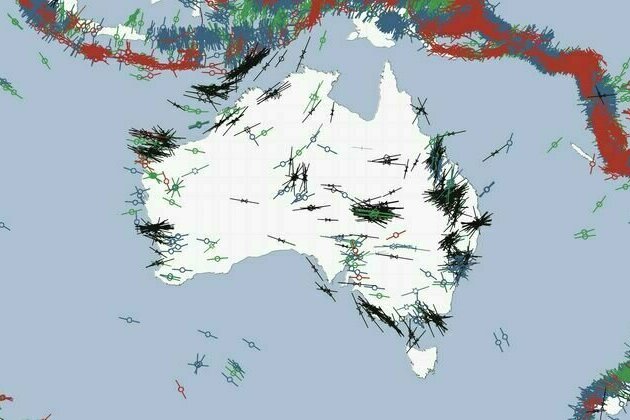
The map below shows just how widespread earthquakes and active faults are across the continent.
Over the past four decades, scientists have built up a detailed picture of the stresses acting in the Australian crust. This comes from many sources including earthquake information, borehole data, mining sites, and large-scale engineering projects.
The results have been compiled in two projects: the Australian Stress Map and the World Stress Map. These show Australia's stress patterns are highly variable and different from those of other continents.
Unlike some continents, where the direction of maximum horizontal stress tends to line up neatly with the movement of plates, Australia's stresses twist and turn, changing direction across the country. Large-scale computer modeling shows this can be explained by the combined effect of tectonic forces at the edges of the Indo-Australian Plate.
The recent earthquake occurred near Kilkivan, west of Gympie, in an area where many faults are aligned in a northwest-southeast direction. One of the most important of these is the North Pine Fault System, a wide zone made of many separate fault segments.
This network of fractures tells a long geological story of movement, stretching back millions of years, that has shaped the landscape of eastern Australia. Geoscientists believe the fault system is quite ancient - between around 50 million and 250 million years old.
However, there have been numerous modern earthquakes in the surrounding region, which suggests the fault system may still be active. The area has experienced several significant earthquakes in the past, including events in 1883, 1918, 1935 and more recently, 2015.
The maximum stress in this region is directed from northeast to southwest. The driving forces come from far beyond Australia.
The Australian tectonic plate is compressed from the north and east by the Pacific plate, particularly along boundaries near the New Hebrides, the Solomon Islands, and the Tonga-Kermadec zone which stretches from New Zealand to Tonga. This compression reaches deep into Queensland.
It is these forces from distant plate boundaries that are behind Australian earthquakes like the recent one in Kilkivan, even though we are far from the world's active plate edges.
Since Saturday morning's earthquake, more than 15 aftershocks have been recorded. Most have been quite small, with magnitudes less than 2.0. A main shock of the moderate magnitude experienced near Gympie will typically produce an aftershock as large as magnitude 4.5, in addition to the many more smaller events.
So, as the crust adjusts to the changes in local stress produced by this earthquake, seismic activity is expected to continue for days or weeks, but with overall smaller and less frequent earthquakes as time goes on.
Get a daily dose of Perth Herald news through our daily email, its complimentary and keeps you fully up to date with world and business news as well.
Publish news of your business, community or sports group, personnel appointments, major event and more by submitting a news release to Perth Herald.
More InformationPune (Maharashtra) [India], August 19 (ANI): Former Army Chief Gen Manoj Naravane recently launched his book, 'The Cantonment Conspiracy,'...
ABU DHABI, 18th August 2025 (WAM) -- The Central Bank of the UAE (CBUAE) announced the increase in money supply aggregate M1 by 0.4%,...
Tel Aviv [Israel], August 17 (ANI/TPS): The IDF (Israel Defence Forces) attacked energy infrastructure used by the Houthi terrorist...
Mumbai (Maharashtra) [India], August 17 (ANI): India's foreign exchange reserves rose by USD 4.747 billion in the week that ended August...
New York [US], August 17 (ANI): Former Pakistani Foreign Minister Hina Khar has accused India of being a 'belligerent' and 'hegemonic'...
New Delhi [India], August 17 (ANI): Former diplomat Veena Sikri on Saturday condemned Pakistani government officials for 'paying homage'...
DUBLIN, Ireland: Accenture has announced it will acquire Australian cybersecurity provider CyberCX, which it says will be its largest-ever...
DOHA, Qatar: The head of Qatar's small Baha'i community has been sentenced to five years in prison for social media posts authorities...
DUBLIN, Ireland: Former president Mary Robinson has voiced shock and outrage over what she described as mass starvation in Gaza. ...
Ludhiana (Punjab) [India], August 19 (ANI): Young cricketer Anmoljit Singh from Ludhiana has earned a place in the India Under-19 cricket...
Share article Print article Last Saturday at 9:49am local time, a magnitude 5.6 earthquake occurred about 50km west of Gympie in...
(Photo credit: Aaron Doster-Imagn Images) Second-seeded Carlos Alcaraz won the Cincinnati Open title on Monday when top-seeded Jannik...