BEIJING, Aug. 5 (Xinhua) -- As innovation and design emerge as new engines of growth, China's manufacturing sector is undergoing a shift from scale-driven expansion to value-oriented transformation.
In the first half of 2025, robust output in high-tech sectors, ranging from 3D printing and smart home appliances to personalized electric vehicles, highlighted the rise of smart manufacturing, where aesthetic design, intelligent production and cultural branding are reshaping global perceptions of "Made in China."
Chinese manufacturers, notably, are no longer just producers -- they are becoming trendsetters amid growing global demand for design-led products.
At the forefront are brands such as Laopu Gold, which fuses traditional Chinese craftsmanship with contemporary aesthetics. Its first overseas store in Singapore, inaugurated in June this year, drew hours-long queues with over 90 percent of visitors being first-time customers, who were drawn by the brand's design, craftsmanship, and the symbolic meaning behind its products, according to a J.P. Morgan report.
Founded 16 years ago, the brand has carved out a new niche in the traditional jewelry market via innovative design and business models. In 2024, the brand's revenue and profit surged by 166 percent and 254 percent, respectively -- a growth trajectory that has continued in 2025.
In the realm of pop culture, Chinese brand Pop Mart has become a global sensation, with fans lining up for dozens of meters outside stores eager to get their hands on the latest trendy Labubu figurine. "Design is our core competitiveness," said a company representative -- citing the firm's 2,000-person design team that crafts everything from sketches to material texture.
More design-powered consumer goods are gaining strong footprints in international markets. A ceramic company from Fujian Province in east China, for example, secured orders worth 2 million yuan (about 280,000 U.S. dollars) in overseas markets for its fruit-themed tableware, while on cross-border e-commerce platforms, sales of solar-powered fan hats from Zhejiang's Yiwu, also located in east China, topped half a million units.
"The popularity of traditional gold craftsmanship and domestic brands like Labubu and Laopu Gold exemplifies how cultural and design premiums are reshaping the value structure of China's manufacturing," said Wu Yin, a professor at the Southwestern University of Finance and Economics.
Rapid advances in digital technology are enabling culturally-rich Chinese design elements to better integrate with industrial production, continuously enhancing the brand value of "Made in China," Wu said.
This growing emphasis on design and innovation is supported by stronger intellectual property (IP) protection efforts during the 14th Five-Year Plan period (2021-2025), which are helping drive China toward global innovation leadership. Between 2020 and 2024, China's total imports and exports of IP royalties grew at an average annual rate of 5.7 percent.
According to the Global Innovation Index released by the World Intellectual Property Organization, China climbed to 11th globally in 2024 -- remaining the top performer among middle-income economies.
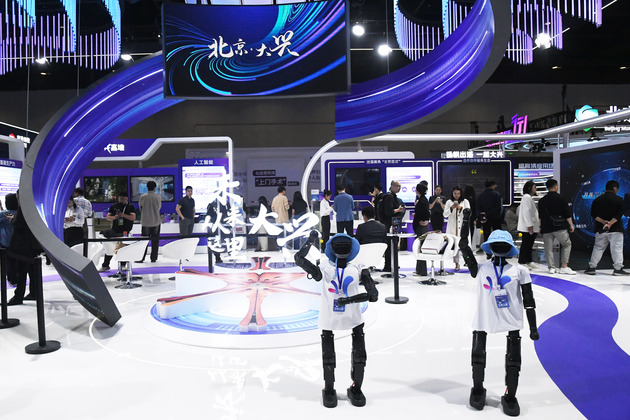
The impact of design innovation is also extending beyond consumer markets into high-end equipment and industrial systems. At the China International Supply Chain Expo held last month in Beijing, a new wave of smart products ranging from humanoid robots to bionic hands showcased the deepening role of the industrial design in advanced manufacturing.
Industrial design has been integrated into the entire manufacturing value chain through product design, process innovation and business model development, said Guan Bing, director of an industrial economics institute at the China Center for Information Industry Development.
"The more sophisticated and advanced the design, the higher the demands it places on digitalization and intelligent manufacturing -- in turn driving the upgrade of the entire production chain," Wu said.
In the electric vehicle field, carmaker Xiaomi has merged aesthetics and automation in its latest product line, with its YU7 model's clamshell-style hood and customizable color features reflecting new consumer preferences.
Behind the scenes, the company's factory operates with over 700 robots, while one-piece die-casting technology has cut component counts from 72 to 1 -- reducing production time by 74 percent.
Buoyed by China's rapid advancements in advanced technologies such as artificial intelligence (AI), industrial design itself is undergoing a rapid transformation. At automotive design firm IAT, engineers now generate styling concepts via voice prompts and AI tool -- accelerating design cycles by 50 percent.
An industry report showed that the value of China's AI industry exceeded 700 billion yuan in 2024, with annual growth above 20 percent for consecutive years. Homegrown AI products are increasingly integrated into sectors like industrial design, education and content creation, driving a multi-sector smart application ecosystem.
As a new wave of technological revolution and industrial transformation is accelerating -- deep integration of AI-assisted industrial design and manufacturing will unlock greater possibilities for intelligent manufacturing, Guan added.
However, gaps remain. Despite the rapid growth of its manufacturing sector, China's innovation capabilities still lag behind, held back by a mismatch between industrial expansion and the slower pace of talent development and education reform. Limited awareness and investment in design, along with a short-term profit-driven mindset among some enterprises, have further compounded the challenges.
"To foster design innovation, it is crucial to build incentive mechanisms and strengthen IP protection," said Ke Bin, a researcher at an industry center under the Ministry of Industry and Information Technology.
Ke called for a value assessment system to encourage greater investment in design by enterprises, and more cross-disciplinary training programs aligned with the needs of intelligent manufacturing.
According to a recent McKinsey report, China's continued policy drive for intelligent manufacturing and industrial automation, coupled with breakthroughs in innovative technologies such as industrial internet platforms and large models, is expected to propel its automation industry to account for over one-third of the global market by 2025, with further "leapfrog growth" projected over the next five years.



 Share
Share
 Tweet
Tweet
 Share
Share
 Flip
Flip
 Email
Email